



Play 4 Clues 1 Word online and connect four image clues to one answer using vocabulary, lateral thinking, letter tiles, and helpful hints.
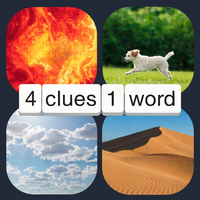
Here's a quick look at the game:
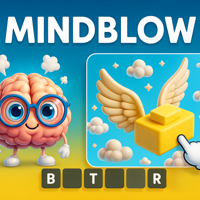
4 Clues 1 Word is a browser-based word puzzle where you study four visual clues and find the single word that connects them. Instead of simply identifying what appears in each picture, you often need to think about different meanings of the same word, then build your answer from the available letter tiles.
What Is 4 Clues 1 Word?
4 Clues 1 Word is a single-player thinking and vocabulary game built around word association. Each puzzle shows several images, typically four, that appear unrelated at first. Your task is to work out the common word that makes sense for all of them.
The important part is that the connection is not always a physical object. A picture may represent an action, an idea, a place, or one meaning of a word with several definitions. For example, a word such as "draft" could refer to a rough version of a document or a current of air. That kind of multiple-meaning connection is central to the puzzles.
Once you think you know the answer, you select letters from the available tiles to fill the answer spaces. A correct word lets you continue to the next puzzle.
As you progress through 4 Clues 1 Word, the relationships between the images can become less obvious, so vocabulary alone is not enough. You also need pattern recognition and lateral thinking.
How to Play 4 Clues 1 Word
The basic rules of 4 Clues 1 Word are simple, but solving harder puzzles requires you to look beyond the most obvious interpretation of each image.
Study All Four Clues
Start by looking at every picture before entering an answer. Try to describe each clue with several words instead of choosing only the first object you recognize.
For example, an image of a runner could suggest "run," "race," "speed," "sport," or "track." An image of a railway may also suggest "track." If another clue points toward music recording or footprints, "track" suddenly becomes a much stronger possibility.
That is the type of connection you are searching for in 4 Clues 1 Word.
Look for Multiple Meanings
Many puzzles are based on polysemy: one word having several related or completely different meanings.
This means two pictures do not necessarily need to show similar things. One may represent a literal object while another represents an action or abstract concept.
When the clues seem impossible to connect, ask yourself whether one English word could be used in several different contexts. Words such as light, spring, match, point, bank, draft, stock, or track illustrate the type of flexible vocabulary that can be useful when solving these puzzles.
Check the Answer Length
The empty answer spaces provide another clue. If your idea has seven letters but only five spaces are available, you can immediately eliminate it.
Use the answer length together with the pictures. If you have several possible synonyms, the number of spaces can help identify which one the puzzle expects.
Build the Word With Letter Tiles
After choosing a possible answer, click or tap the letters in the correct order. The selected letters fill the answer spaces.
If your first attempt does not work, reconsider the connection rather than repeatedly entering random combinations. In 4 Clues 1 Word, understanding how the images relate is usually more useful than brute-forcing the available letters.
Controls
4 Clues 1 Word uses simple point-and-click or touchscreen controls, so there are no movement keys or complicated commands to learn.
| Action | Control |
|---|---|
| Select a letter | Click or tap a letter tile |
| Build your answer | Select letters in order |
| Interact with menus | Click or tap |
| Use a hint | Click or tap the available hint option |
| Desktop play | Mouse |
| Mobile play | Touchscreen |
The browser version is designed around direct interaction with the puzzle interface. You can therefore focus on solving the word rather than learning keyboard controls.
Hints in 4 Clues 1 Word
When a connection refuses to appear, 4 Clues 1 Word provides hint options that can reduce the number of possibilities.
One type of hint reveals a correct letter in the solution. This is particularly useful when you already understand the general connection but cannot decide between similar words.
Another option can remove letters that are not needed for the answer. Eliminating incorrect tiles makes it easier to recognize possible words from the remaining letters.
Hints are most valuable after you have already analyzed the pictures. Using one immediately may solve part of the puzzle, but trying the clues yourself first gives you a better chance of spotting the same type of wordplay in later levels.
Tips for Solving 4 Clues 1 Word
1. Name Each Image in Several Ways
Do not stop at "dog," "car," or "tree." Give each image three or four possible labels, including actions and ideas connected to it.
The shared answer often appears only after you broaden your description of the clues.
2. Start With the Strangest Image
If three images have many possible meanings but one is very specific, analyze the unusual clue first. It may drastically reduce the number of possible answers.
This method is especially useful in harder 4 Clues 1 Word puzzles where the obvious pictures are deliberately ambiguous.
3. Say Possible Words Out Loud
Some connections are easier to notice when you hear the word. Say a candidate answer and mentally place it beside each picture.
Ask: "Does this word naturally describe clue one? What about clue two, three, and four?"
If you have to invent a complicated explanation for one image, your answer is probably wrong.
4. Think About Verbs and Adjectives
A common mistake is assuming every answer must be a noun because the clues are photographs.
An image can represent an action, condition, or quality. Consider verbs, adjectives, concepts, and expressions as well as objects.
This change in perspective can solve many difficult 4 Clues 1 Word levels.
5. Use the Letters as Evidence
The letter bank is not just an input method. It is another part of the puzzle.
After developing two or three possible answers, check whether the required letters are available. You can often eliminate a promising-looking idea immediately because one essential letter is missing.
6. Do Not Force One Interpretation
If three clues support your answer but the fourth does not, reconsider it. The correct solution should provide a reasonable link to every clue.
The challenge of 4 Clues 1 Word comes from finding the shared word, not simply finding something that matches most of the pictures.
7. Save Hints for Genuine Sticking Points
Try identifying categories, synonyms, alternate meanings, and answer length before using a hint. When you do need help, revealing one letter may be enough to trigger the solution without giving away too much.
What Makes the Puzzles Different?
4 Clues 1 Word differs from straightforward picture-identification games because the answer can depend on how a word is used in different situations.
You might see four images from completely different subjects—food, finance, nature, and everyday life—but still discover that one English word belongs to every scene.
This creates a useful solving rhythm. First you recognize the visible objects, then you stop thinking literally and search for the linguistic connection.
The best puzzles produce an "of course" moment when the answer becomes obvious and every clue suddenly makes sense.
Can You Play 4 Clues 1 Word Online?
Yes. The browser version of 4 Clues 1 Word can be played online without installing a separate game application. It is available for desktop browsers and is also designed for touchscreen interaction on compatible mobile devices.
Because the game relies primarily on clicking or tapping letters, it translates naturally between mouse and touch controls.
That also makes 4 Clues 1 Word suitable for short sessions. You can solve a few puzzles at a time without needing to learn a complicated control system or complete a long match.
Who Is 4 Clues 1 Word For?
4 Clues 1 Word is best suited to players who enjoy vocabulary games, visual riddles, word associations, and logic puzzles.
You do not need quick reflexes. Progress comes from observing details, testing possible meanings, and finding connections between ideas.
English learners may also find the format useful for encountering words with several meanings, although some puzzles can be difficult if they depend on less familiar vocabulary or expressions.
Players who like games where one difficult puzzle can occupy several minutes will probably get more from 4 Clues 1 Word than players looking for action or competitive multiplayer gameplay.
Why Players Keep Solving
The main appeal of 4 Clues 1 Word is the transition from confusion to recognition. Four pictures can initially look completely unrelated, but one small vocabulary connection can suddenly make the entire puzzle clear.
The controls stay simple while the reasoning becomes more demanding. That means difficulty can increase without adding complicated mechanics.
There is also little penalty in examining a puzzle slowly. You can compare images, reconsider synonyms, test meanings, and use a hint when necessary. For players who prefer untimed thinking over reflex challenges, that structure works well.
FAQ
Is 4 Clues 1 Word free to play?
The browser version of 4 Clues 1 Word is available to play online for free on supported game portals.
What is the goal of 4 Clues 1 Word?
Your goal is to identify the single word that connects the visual clues and spell it using the provided letters.
Does 4 Clues 1 Word require a download?
No. The browser version can run online without downloading or installing the game.
Can I play 4 Clues 1 Word on mobile?
Yes. Compatible browser versions support touchscreen controls, allowing you to select letters and interact with the puzzle by tapping.
What should I do when I cannot find the answer?
Describe every image in several ways, consider words with multiple meanings, check the answer length and available letters, then use a hint if you are still stuck.
Is 4 Clues 1 Word a multiplayer game?
The browser game is presented as a single-player word puzzle rather than a competitive multiplayer game.