

Decode encrypted quotes in Cryptograms: Secret Text by replacing hidden letters, spotting word patterns, and using hints when a puzzle gets difficult.

Here's a quick look at the game:
What Is Cryptograms: Secret Text?
Cryptograms: Secret Text is a word and logic puzzle game where you decode encrypted phrases one letter at a time. Each level hides a quotation or message behind substituted letters, and your task is to work out which real letters belong in each position.
Instead of guessing an entire sentence at once, you gradually rebuild it from partial information. A correct letter can expose useful patterns in several words, while a wrong assumption can send your solution in the wrong direction. The main challenge is recognizing vocabulary, sentence structure, and repeated letter patterns until the hidden phrase becomes readable.
The game also lets you choose between different categories of quotations, including themes based around love and relationships, wisdom and philosophy, movies and TV, motivation, and literature.
How to Play Cryptograms: Secret Text
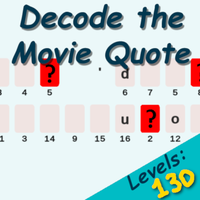
Each puzzle displays an encrypted phrase with letters that need to be identified. Select a coded letter and choose the normal alphabet letter you think should replace it.
The important rule is that the cipher is consistent. When the same encrypted symbol or letter appears several times, it represents the same decoded letter throughout that puzzle. This means every correct choice gives you information in more than one place.
A useful solving process is:
- Look over the entire encrypted phrase before guessing.
- Find short words and repeated letter patterns.
- Select a coded letter and assign a possible replacement.
- Check how that replacement affects other words.
- Use the new information to solve additional letters.
- Continue until the complete hidden phrase is revealed.
You do not need to solve the words from left to right. In many levels, identifying one obvious word near the middle of the sentence can provide the letters you need to unlock several other words.
How to Read the Cipher
Start With Short Words
Short words can provide some of the strongest clues. A one-letter English word is usually A or I, while common two- and three-letter words can quickly narrow the possibilities.
If you see the same short encrypted word several times, pay particular attention to it. Solving a frequently repeated word can reveal letters across the entire quotation.
Look for Repeated Letters
Letter patterns are often more useful than the letters themselves.
For example, a coded word with the pattern 1-2-2 has two matching letters at the end. That immediately rules out many possible words. Longer words containing repeated characters can provide even stronger clues.
Do not ask only, "What word fits here?" Also ask, "What word has this exact letter pattern?"
Use the Sentence Around the Word
Cryptograms are easier when you treat the puzzle as a complete sentence rather than a collection of isolated words.
Grammar can tell you what kind of word belongs in a position. After words such as "the," you might expect a noun or adjective. A phrase beginning with "I" may quickly suggest common verbs. Punctuation can also reveal where one idea ends and another begins.
Controls
The puzzle is primarily controlled by selecting letters and interface buttons.
| Action | Control |
|---|---|
| Select an encrypted letter on PC | Left-click |
| Choose a replacement letter | Click the required letter |
| Select letters on mobile | Tap |
| Use a hint | Click or tap the available hint button |
| Navigate menus | Click or tap |
Because the gameplay focuses on letter selection rather than movement, you can concentrate on the cipher without learning complicated controls.
Hints and Coins
Cryptograms: Secret Text includes hints for situations where you cannot make further progress. Hint options can reveal useful information and help you break through a difficult section of a phrase.
Completing levels earns coins, which can be used for additional hints. This creates a useful trade-off: you can spend help immediately when stuck, or try to solve more of the cipher yourself and keep your coins for harder puzzles.
A hint is usually most valuable when one unknown letter is blocking several words. Revealing that single character may give you enough information to finish a large part of the quotation.
Tips for Solving Cryptograms Faster
Do Not Guess Long Words Too Early
A long encrypted word may look distinctive, but there can still be many possible answers when you know none of its letters.
Start by confirming easier parts of the sentence. Once several letters are known, return to the long word and use its newly revealed pattern.
Check Every Replacement in Multiple Places
Before becoming confident about a letter, inspect every place where it appears.
If your replacement creates a sensible word in one position but nonsense somewhere else, the guess is probably wrong. A strong solution should make several parts of the sentence more plausible at the same time.
Use Common Endings
Look for possible endings such as -ING, -ED, -ER, -LY, and -TION. If some letters in a longer word are already known, recognizing a common suffix can reveal several more characters at once.
Prefixes can help too. Patterns that might form RE-, UN-, DIS-, or PRE- are worth checking when the surrounding sentence supports them.
Pay Attention to Apostrophes
Words containing apostrophes can be excellent clues. Patterns may represent common contractions such as don't, can't, it's, I'm, or you're.
The length of each section around the apostrophe greatly reduces the number of possible answers.
Use Punctuation as Information
Commas, periods, question marks, and quotation structure are not just decoration. They show how the sentence is organized.
If you can understand the grammatical role of a section, you can often predict what type of word is missing before you know any of its letters.
Avoid Random Letter Testing
Random guessing may occasionally work, but it becomes inefficient as puzzles get longer. Each choice should ideally be supported by a word pattern, repeated letter, grammar clue, or another part of the phrase.
The more confirmed information you collect, the fewer possibilities remain.
Choosing a Puzzle Theme
You can solve phrases from several themed categories rather than working through only one type of quotation. Available selections include subjects such as love and relationships, wisdom and philosophy, movies and TV shows, motivation, and literature.
The basic decoding rules stay the same, but changing themes can alter the vocabulary you expect to encounter. If you know you are solving a movie-related phrase, for example, that context may help you recognize a partially decoded quotation.
A Reliable Strategy When You Get Stuck
When progress stops, scan the puzzle again instead of repeatedly attacking the same difficult word.
Look for the shortest unsolved word, a repeated pattern, a double letter, an apostrophe, or a word where several characters are already known. Solving just one of those areas can create a chain reaction across the rest of the cryptogram.
If there are still too many possibilities, use a hint on a letter that appears several times. One well-chosen reveal is usually more useful than focusing on an isolated character that occurs only once.
Cryptograms: Secret Text rewards careful deduction rather than speed. Build your solution from the strongest clues, verify each replacement across the entire phrase, and let confirmed letters gradually expose the secret text.