






Play Word Solitaire online, sort word cards into matching categories, manage limited moves, clear the board, and use boosters when a puzzle gets difficult.
Here's a quick look at the game:
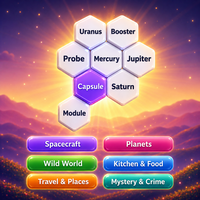
Word Solitaire is a word-association puzzle built around solitaire-style card sorting. Instead of arranging normal playing cards by number or suit, you find category cards and place related word cards into the correct groups. Clear every category from the board to complete the level.
What is Word Solitaire?
Word Solitaire combines a card-table layout with a vocabulary and association puzzle. Each level contains category cards and individual word cards. Your job is to work out how the words are connected and organize every card into its correct category.
For example, a category might relate to food, animals, objects, places, or another familiar topic. Once you identify a category card, you can start adding words that belong to that group.
The solitaire element comes from the way the cards are arranged and revealed. You cannot simply see every answer and sort them in any order. You need to work with the available cards, uncover more of the board, and make placements that leave room for later moves.
Word Solitaire becomes more difficult as the levels introduce less obvious associations and more decisions about where a card belongs. Some words may initially seem connected to more than one idea, so reading the available categories before moving a card is important.
Game Overview
| Feature | Details |
|---|---|
| Game | Word Solitaire |
| Genre | Word puzzle, card puzzle, association game |
| Main Goal | Sort every word into its correct category |
| Core Mechanic | Drag word cards onto matching category groups |
| Play Style | Single-player puzzle |
| Controls | Mouse or touchscreen |
| Browser Play | Yes |
| Mobile Support | Yes |
| Level Progression | Increasingly challenging puzzles |
| Boosters | Available |
| Developer | Not clearly listed |
| Multiplayer | Not clearly listed |
How to Play Word Solitaire
The basic rule in Word Solitaire is easy: match related words with the correct category card. The challenge is completing the entire board efficiently rather than making one obvious match at a time.
Find a Category Card
Start by looking for category cards among the cards currently available.
A category card establishes the theme for a group. Once you know what that group represents, you can begin looking for words that logically belong with it.
Do not rush to move the first word you recognize. Check the visible category cards first. Knowing the available themes makes it much easier to decide where an ambiguous word should go.
Drag Words Into Their Categories
When you find a matching word, drag its card to the corresponding category.
Suppose one group represents animals. Words naming animals should be placed with that category rather than mixed into another stack. Continue adding related cards until the group is complete.
Word Solitaire is therefore less about spelling words and more about understanding relationships between words.
Stack Cards From the Same Group
Cards belonging to the same category should be collected together.
Completing these groups helps clear the playing area and gives you more room to deal with the remaining cards. This is why the order of your moves can matter.
If you can finish an almost-complete category, doing so may be more useful than opening several new groups at once.
Reveal More Cards
Some cards are not immediately available at the beginning of a Word Solitaire level.
As you move exposed cards and work through the layout, more words or categories become accessible. These newly revealed cards may confirm an association that was unclear earlier.
Before making a risky placement, check whether another simple move can reveal additional information first.
Clear Every Category
You win a Word Solitaire level after all of the required words have been matched with their correct categories and the board has been cleared.
Later puzzles require more careful association and planning. Finding one correct pair is usually easy; keeping the whole board organized is the real challenge.
Understanding Word Associations
Word Solitaire does not usually connect cards through spelling. It connects them through meaning.
A word may belong to a broad subject, describe an object, name part of a larger group, or share another recognizable relationship with the category card.
For that reason, you should think about meaning before visual similarity.
If you see a word you do not immediately understand, leave it temporarily when possible and solve clearer matches first. Other categories can give you enough context to identify the difficult card later.
This elimination strategy becomes increasingly useful as Word Solitaire levels become more complex.
Controls
Word Solitaire uses direct card controls rather than keyboard movement.
| Action | Control |
|---|---|
| Select a card | Click or tap the card |
| Move a word card | Drag it to the matching category |
| Move a category card | Drag it to an available position when required |
| Use a booster | Click or tap the appropriate booster |
| Navigate menus | Mouse or touchscreen |
On a desktop computer, use the mouse to drag cards. On a phone or tablet, touch and drag the cards across the screen.
There are no WASD or arrow-key movement controls to learn, so you can begin playing Word Solitaire as soon as you understand the category rule.
How Limited Moves Affect Your Strategy
Word Solitaire is not only about knowing that two words belong together. Efficient card management can also matter.
Some versions of the levels give you a limited number of moves. This discourages random testing and makes it useful to plan before dragging a card.
When several options are visible, prioritize moves you are confident about.
A correct association clears useful space and moves the puzzle forward. A speculative move can consume resources or leave the board in a less convenient state.
You do not need fast reactions. Take time to inspect all visible words and categories before committing to a difficult choice.
Boosters in Word Solitaire
Word Solitaire includes boosters that can help when a puzzle becomes difficult.
The exact options available can depend on the level or version being played, so check the icons shown on your current game screen before using one.
A booster is most valuable when you have already solved the obvious associations but cannot determine where one of the remaining cards belongs.
Avoid using help immediately after seeing an unfamiliar word. First complete the easier categories. Once several groups have disappeared, elimination may reveal the correct answer without requiring assistance.
Tips for Word Solitaire
Read Every Category Before Moving Cards
The category cards provide the context for the entire puzzle.
If you begin sorting without checking them, a word with several possible meanings can easily send you in the wrong direction. Spend a few seconds reviewing the available groups first.
Complete Obvious Groups Early
When a category has several clear matches, work on it first.
Finishing a simple group reduces the number of cards you need to consider. A crowded Word Solitaire board becomes much easier to read after one or two categories are removed.
Use Elimination for Ambiguous Words
Do not force a difficult word into a category immediately.
Solve the cards you understand first. If only one category remains after other groups are completed, the relationship may become obvious.
Think About Meaning, Not Spelling
Two cards do not need to share letters to belong together.
Word Solitaire focuses on associations. Ask questions such as: Is this an animal? Is it something you eat? Is it connected with travel? Is it an object used for a particular activity?
Avoid Random Dragging
Testing every category may seem like a quick way to find an answer, but it removes much of the useful reasoning from the puzzle and can be costly when moves are limited.
Use the category names and the remaining cards to make a reasoned choice.
Look at What a Move Reveals
A card can be valuable for more than its category.
Moving it may expose another card underneath. When you have several equally clear choices, consider which move reveals the most useful new information.
Finish Nearly Complete Categories
If a group needs only one more card, look for that answer before opening another category.
Clearing a completed stack can simplify the board and make the remaining associations easier to see.
Word Solitaire vs Classic Solitaire
Despite the name, Word Solitaire does not require you to memorize the normal rules of Klondike or another traditional solitaire variant.
Classic solitaire usually revolves around numbers, suits, colors, and card order. Word Solitaire replaces those relationships with categories and vocabulary.
You still get the feeling of clearing a card table piece by piece, but the decisions depend on language rather than whether a black seven can be placed on a red eight.
This makes Word Solitaire a better fit for players who enjoy card layouts but prefer logic and vocabulary questions to standard playing-card rules.
Why Players Keep Playing Word Solitaire
The main appeal of Word Solitaire is the gradual process of making sense of a messy board.
At first, you may see several unrelated words and category cards. After a few correct matches, patterns start appearing. Complete groups disappear, hidden cards become available, and the number of possible relationships gets smaller.
There is also a useful balance between knowledge and deduction. You do not need an unusually large vocabulary to solve every Word Solitaire puzzle. When one association is unfamiliar, completing the other groups can often reveal where the remaining card must belong.
Because there is no need for quick movement or precise timing, Word Solitaire suits players who prefer puzzles that allow them to stop and think. A level can be approached slowly, with each move chosen after checking the full board.
The game is especially suitable if you like word association puzzles, sorting games, casual solitaire variations, or short logic challenges that can be played directly in a browser.
FAQ
What is Word Solitaire?
Word Solitaire is a card-based word puzzle where you sort words into matching categories and clear all of the groups from the board.
How do you play Word Solitaire?
Find a category card, identify words connected to that category, and drag those word cards into the correct group until every card has been sorted.
Can I play Word Solitaire online?
Yes. Word Solitaire is available as an HTML5 browser game and can be played without installing a traditional desktop game.
Can I play Word Solitaire on mobile?
Yes. Browser versions of Word Solitaire support touchscreen devices as well as desktop computers.
Is Word Solitaire the same as classic solitaire?
No. It uses a solitaire-style card layout, but cards are matched through word categories and associations instead of normal suits and numbers.
Does Word Solitaire have boosters?
Yes. Boosters are available to help with difficult puzzles, although the exact tools shown can vary during play.
How do you win a Word Solitaire level?
Sort all of the word cards into their correct category groups and clear the entire playing field.
What is the best Word Solitaire strategy?
Solve clear associations first, avoid random placements, finish nearly completed groups, and use elimination to deal with words that could fit more than one category.